
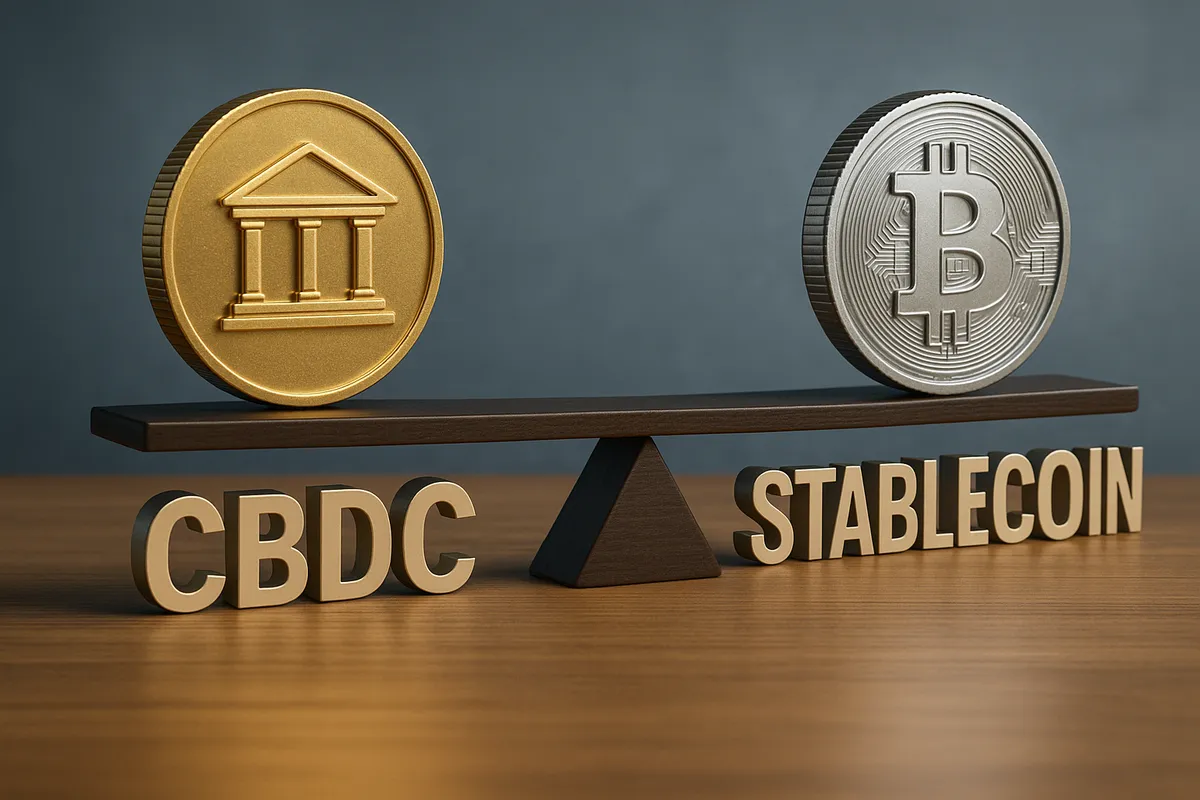
Central banks and private issuers are shaping the future of digital money. Stablecoins, created to reduce cryptocurrency volatility, have grown into a USD 300 billion market, dominated by USDT and USDC according to SUERF. At the same time, governments are developing central bank digital currencies, or CBDCs, with pilots underway in China, the European Union and India, as outlined by PwC.
Stablecoins aim to provide stability to crypto markets by pegging tokens to assets such as fiat currency, bonds or commodities. McKinsey describes them as “tokenized cash issued by private institutions,” often operating on public blockchains and backed by reserves. Their designs vary widely, from fiat-backed models like USDC to crypto-collateralised systems like DAI and algorithmic models such as TerraUSD, the latter having collapsed in 2022. Platforms like Flipster note that transparency and reserve quality remain critical for trust.
CBDCs, by contrast, are issued directly by central banks and have legal-tender status. PwC defines them as digital representations of sovereign money that combine secure, fast transactions with the stability of state backing. Retail CBDCs target everyday payments, while wholesale versions focus on interbank settlement, a distinction highlighted by ChainUp. Countries such as the Bahamas and Jamaica already operate live CBDCs, while Europe continues development of the digital euro.
Key contrasts in governance and design
Stablecoins depend on private governance and varying regulatory regimes, making them flexible but vulnerable to reserve-related risks or de-pegging events. CBDCs rely on public trust in central banks and can integrate privacy features, offline capability and monetary-policy tools. Technology also diverges: stablecoins typically use public blockchains and plug into decentralised finance, while CBDCs rely on centralized or permissioned architectures controlled by monetary authorities.
Privacy remains a core point of debate. Stablecoin transactions on public blockchains are transparent but pseudonymous. CBDCs can incorporate different levels of privacy, though industry groups warn about potential surveillance if oversight is not carefully limited. ChainUp and Flipster note that this balance between privacy and compliance will be central to public acceptance.
Policy momentum and geopolitical dynamics
Regulators worldwide are responding. Europe’s Markets in Crypto-Assets (MiCA) framework introduces strict rules for stablecoin reserves and disclosure, while the U.S. adopted the 2025 GENIUS Act, establishing federal rules for payment stablecoins. The Atlantic Council reports that U.S. officials support regulated stablecoins but remain opposed to a digital dollar, in contrast to Europe’s push for a digital euro.
Central banks must also consider financial stability. Rapid adoption of stablecoins could reduce commercial-bank deposits, while a poorly designed CBDC could accelerate bank disintermediation. Policymakers are exploring holding limits and tiered remuneration to mitigate these risks.
Coexistence, not competition
Despite frequent comparisons, CBDCs and stablecoins serve different purposes. Stablecoins drive private-sector innovation, enable global transfers and support DeFi. CBDCs extend public money into the digital era, ensuring monetary sovereignty and universal access to secure payments. The most likely outcome for 2025 and beyond is coexistence, with each model evolving under clearer regulatory frameworks.
As Europe moves forward with digital-euro preparations and global stablecoin use expands, understanding the differences between these systems is essential for banks, businesses and citizens. The coming years will determine how digital money reshapes payments, financial stability and the role of public versus private innovation.