
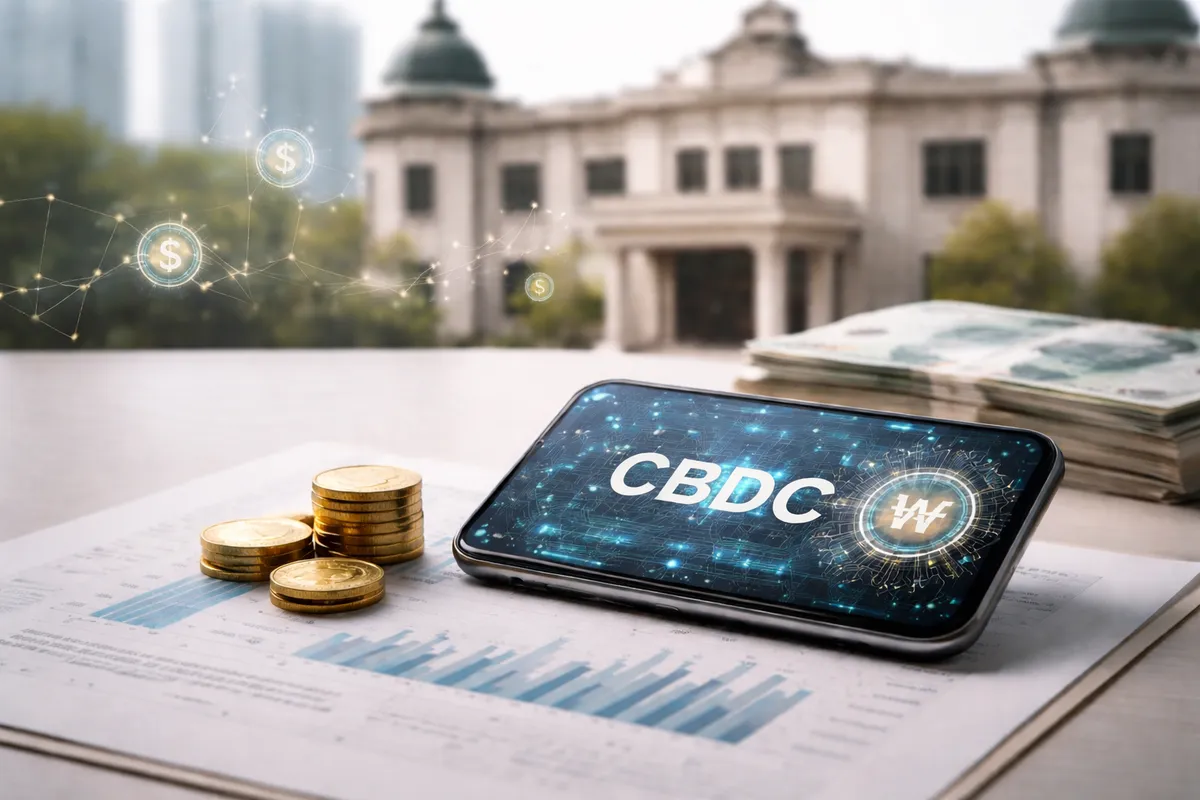
The Bank of Korea is moving quickly to restart its central bank digital currency programme, pushing ahead with a second large-scale pilot despite ongoing delays in legislation for won-denominated stablecoins. The renewed effort signals the central bank’s determination to test practical CBDC use cases even as political and regulatory debates continue.
According to South Korean financial industry sources, the Bank of Korea has recently sent official notices to major domestic banks outlining plans for a second phase of CBDC testing, known internally as Project Hangang. A central bank official confirmed that discussions are underway but said that detailed structures and timelines are still being finalised.
Focus on real-world use cases
Unlike the first pilot, the second CBDC test is expected to place greater emphasis on concrete policy applications. One option under review is the distribution of certain government subsidies in digital won form. By issuing subsidies via CBDC wallets, authorities would be able to restrict where funds can be spent and reduce administrative and compliance costs linked to public transfers.
The approach reflects growing interest among central banks globally in using CBDCs not only as payment instruments, but also as programmable tools that can improve efficiency in fiscal policy delivery.
The Bank of Korea previously ran a first CBDC pilot from April for three months with seven commercial banks. That test was later paused after participants raised concerns over limited real life usability and the high costs imposed on banks, which reportedly reached tens of billions of won.
Stablecoin legislation remains delayed
The renewed CBDC push comes as South Korea continues to struggle with the legal framework for won-backed stablecoins. CBDCs and stablecoins share functional similarities, but differ fundamentally in issuance. A CBDC is issued directly by the central bank, while stablecoins are typically issued by private entities and backed by fiat reserves.
In recent months, disagreements between the Financial Services Commission and the Bank of Korea over who should be allowed to issue won stablecoins and how they should be regulated have slowed legislative progress. A digital asset bill originally expected earlier this month has yet to be finalised.
Draft proposals from the Financial Services Commission reportedly suggest designating systemically important stablecoins based on user numbers and issuance size, with such designations to be made in consultation with the central bank. This is seen as partially reflecting the Bank of Korea’s concerns over financial stability, although key issues such as bank-led issuance consortia and unanimous decision-making within policy coordination bodies remain unresolved.
Lawmakers from the ruling Democratic Party’s digital asset task force are expected to continue discussions, but a final bill may still take time.
Banks prepare despite uncertainty
Commercial banks say they have little choice but to prepare for the second CBDC test. One banking sector official said that once formal notices were received, internal teams had to restart technical and operational preparations regardless of unresolved policy questions.
The Bank of Korea has sought to downplay any direct link between the delayed stablecoin legislation and the CBDC pilot. A central bank official said that CBDCs and stablecoins serve different roles and can coexist, adding that the second test is simply the continuation of previously planned procedures.
For South Korea, the outcome of Project Hangang will be closely watched beyond national borders. As debates over digital money intensify globally, the Bank of Korea’s experience may offer useful insights into how CBDCs can move from theory to targeted real-world deployment.