
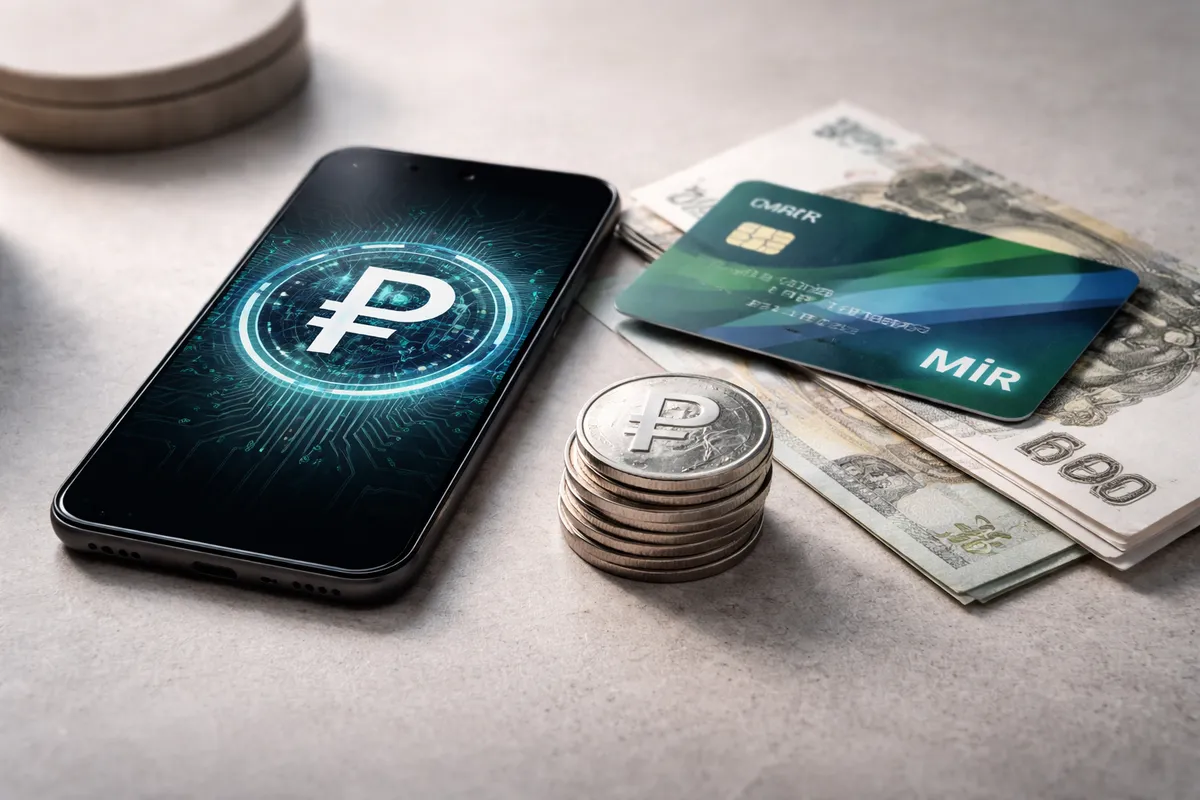
The digital ruble is increasingly being viewed as a future competitor to Russia’s Mir card system, according to market analysts, highlighting how central bank digital currencies could disrupt even domestically dominant payment networks.
Commenting on the outlook for Russian payments, analysts cited by local financial media argue that once the digital ruble is fully rolled out, it could absorb a growing share of everyday retail transactions that currently flow through bank cards. The digital ruble is being developed by the Bank of Russia as a third form of money alongside cash and non-cash bank deposits.
Mir cards rose rapidly after the exit of international card schemes in 2022 and now dominate domestic card payments. However, analysts note that the next phase of competition may come not from foreign networks, but from state-backed digital infrastructure. In particular, a central bank digital currency could enable payments directly between users and merchants without relying on traditional card rails.
According to the analysis, the digital ruble is expected to be launched for wider use around 2026, following ongoing pilot programmes. Its introduction is likely to coincide with the broader expansion of alternative payment methods in Russia, including QR-code and biometric payments, which are already gaining traction at physical points of sale.
Rather than triggering a collapse of the card market, analysts suggest the digital ruble would slow growth in card transactions as consumers diversify how they pay. Cards would remain important, especially for legacy systems and offline use, but their role as the default digital payment method could gradually weaken.
For policymakers, the shift underlines a broader strategic aim. By promoting the digital ruble, the central bank would gain more direct influence over retail payments infrastructure, while reducing dependence on card-based intermediaries. For consumers and merchants, the impact will depend on how seamlessly the digital ruble integrates into existing apps, terminals, and daily routines.