
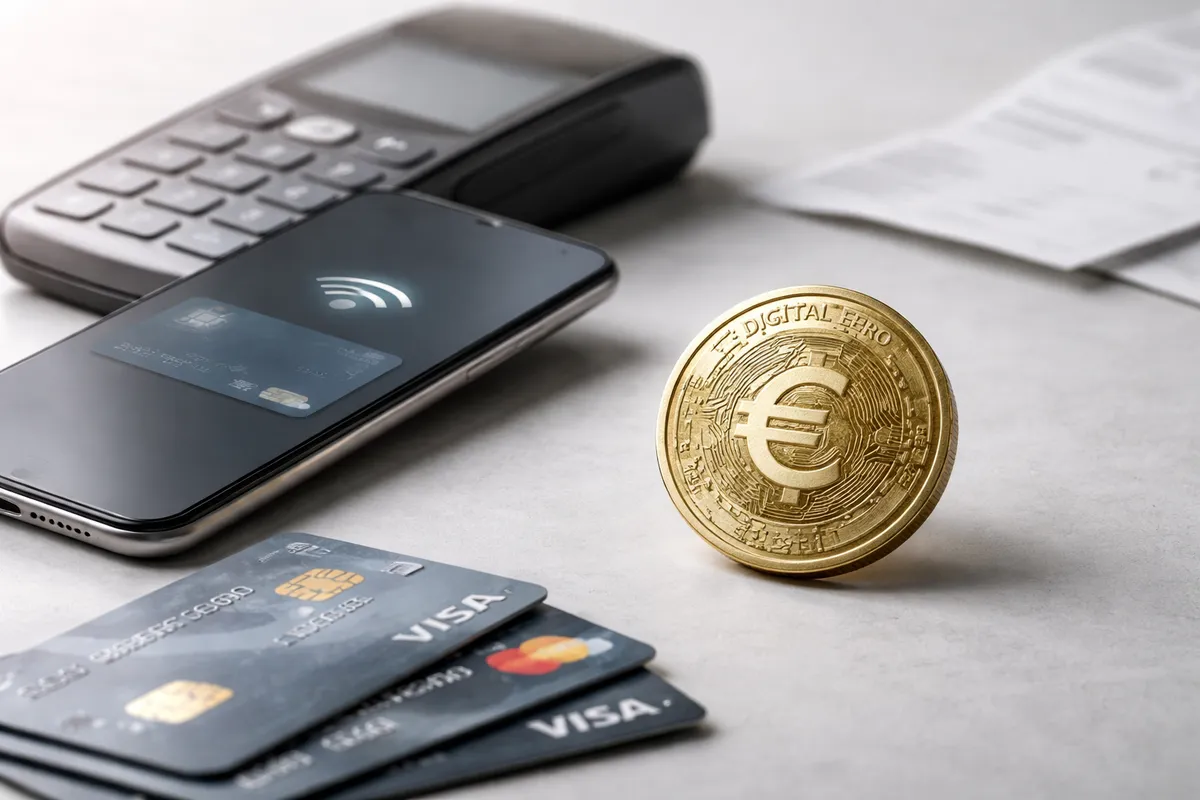
The European Central Bank’s digital euro project is increasingly framed as more than a new form of public money. If EU lawmakers approve the legislation in 2026 as the ECB hopes, and issuance follows around 2029, it could become a new, public payment backbone across the euro area, one that directly challenges today’s market structure dominated by Apple Pay and Google Pay at the device layer and Visa and Mastercard at the scheme layer.
That matters because Europe’s card and wallet ecosystem is deeply dependent on non-European providers. ECB officials have repeatedly highlighted that more than two-thirds of euro area card payments are processed via international schemes, leaving parts of Europe exposed to external commercial and geopolitical pressures.
A Public Rail With New Economics for Merchants and Wallets
The most disruptive element is not the interface, it is the economics and governance. The Commission’s draft regulation would give the digital euro legal tender status, including mandatory acceptance in many circumstances and a prohibition on surcharges, making it structurally harder for merchants to steer consumers away from it once it exists.
At the same time, policymakers are trying to ensure the digital euro is cheap to use. The EU Council’s December 2025 negotiating position backs a model where basic services are free for users, while interchange and merchant service charges are capped for at least five years, and then recalibrated based on actual costs. This directly targets one of the long-running complaints in European retail payments: that scheme and acceptance costs are often opaque and weigh most heavily on smaller merchants.
If the digital euro becomes a widely accepted payment instrument embedded into bank apps and point-of-sale terminals, it could weaken the role of card schemes in “everyday” payments, especially for low-value transactions where fees are most politically sensitive. The ECB has also emphasised open standards and a common rulebook to help providers scale pan-European solutions, which could create more room for European wallets and payment providers to compete at the user experience layer.
Why Apple Pay and Google Pay Are Still in the Fight
Tech commentary has sometimes jumped to “Apple Pay is finished”. A recent Wccftech article argued the digital euro could make Apple Pay “irrelevant”, largely because a CBDC could offer a fee-free alternative and because the ECB is targeting 2029 for a launch window. The political direction is real, but the competitive outcome is not automatic.
First, the digital euro is designed not to be “programmable money”, and it is expected to include holding limits and safeguards to address bank funding risks. That points to a payments-first instrument, not a replacement for bank deposits or the full stack of private payment services. Second, Apple Pay and Google Pay can remain relevant as front-end wallets if they can carry digital euro payment credentials, or if banks distribute digital euro through their own apps while still supporting big-tech wallets for cards and other methods.
Importantly, the EU has also forced Apple to open iPhone NFC access to rival wallet providers in the bloc, lowering Apple Pay’s control over tap-to-pay distribution and making it easier for banks or new entrants to build digital euro-capable wallets on iOS. In other words, even before a digital euro arrives, Brussels is already reshaping the competitive landscape in mobile wallets.
For readers who want deeper background on the ECB’s design direction, see Digital Euro News’ earlier coverage of the ECB technical annex.
The next phase to watch is legislative: the Council’s position now heads into negotiations with the European Parliament. If the political deal lands in early 2026, the practical fight will shift quickly from “whether” to “who controls the user relationship” in a world where Europe has its own public digital payment rail.