
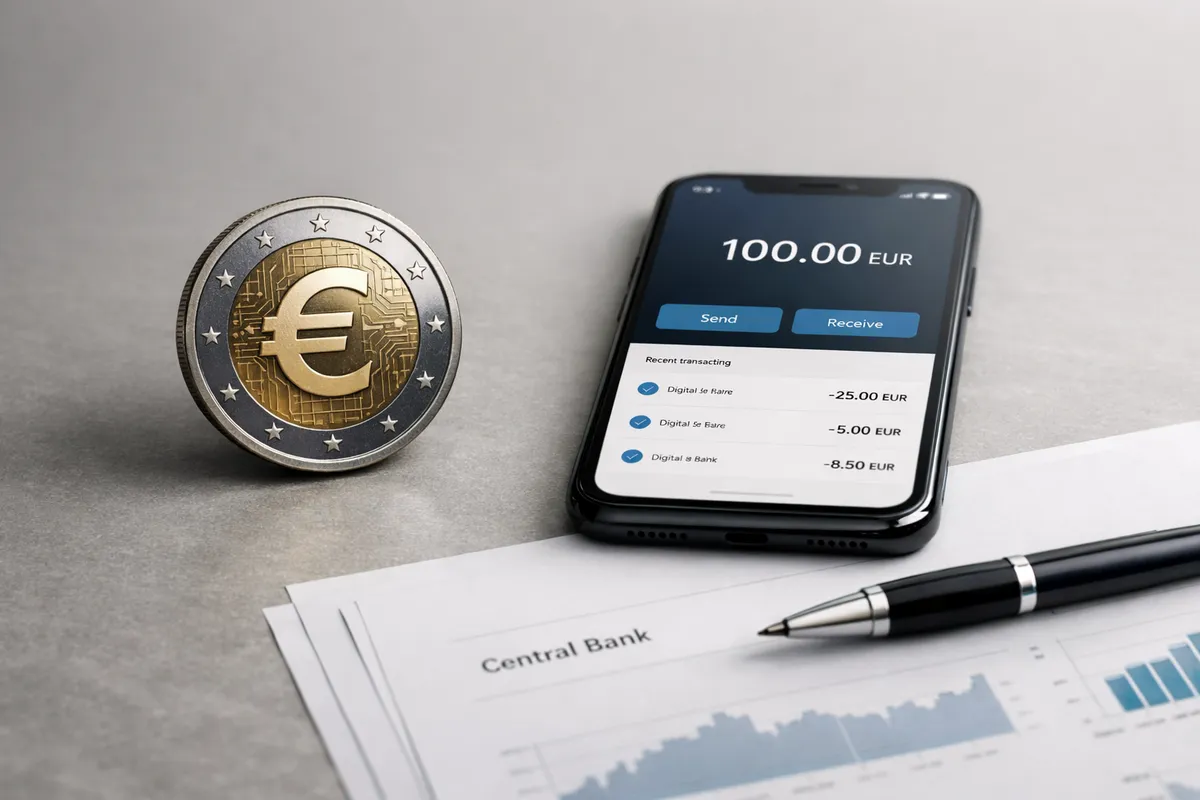
As geopolitical uncertainty reshapes global finance, senior European Central Bank officials are sharpening their message. The digital euro, they argue, is no longer just a payments innovation, but part of Europe’s response to a more fragile, fragmented and politically charged global order.
In interviews published this month, Sharon Donnery and Piero Cipollone set out a common narrative. Europe needs stronger resilience, both in its banking system and in the way citizens and businesses pay, and public money has a central role to play.
Donnery, speaking from the perspective of banking supervision, said geopolitical risk has shifted from an occasional concern to a constant backdrop. Trade tensions, market volatility and cyber threats are no longer abstract scenarios. They are channels through which shocks can quickly reach banks’ balance sheets and operations.
That reality has pushed supervisors to change how they test resilience. Rather than relying on a single macroeconomic scenario, the ECB is now asking banks to run reverse stress tests, identifying the most severe situations that could drain their capital. The exercise forces banks to confront their own vulnerabilities, whether linked to business models, cross-border exposures or currencies, rather than assuming all institutions face the same risks.
At the same time, Donnery was clear about what will not change. Simplifying EU banking rules does not mean loosening them. Capital and liquidity remain the ECB’s red lines, and any reduction in requirements must come from a genuine fall in risk, not from legislative shortcuts. In an era of repeated shocks, she argued, strong buffers are what allow banks to keep lending when it matters most.
That emphasis on resilience runs directly into the ECB’s case for a digital euro. Cipollone framed the project as a way to preserve citizens’ access to central bank money as cash use declines and digital payments dominate everyday life. Cash, he noted, cannot be used online. The digital euro is meant to fill that gap, acting as a digital version of cash that works across all payment situations.
But convenience is only part of the argument. Cipollone pointed to Europe’s heavy reliance on non-European payment providers, with roughly 70 percent of card-initiated transactions processed outside the EU. For something as basic as payments, he said, that dependence is a weakness. A digital euro would anchor payments in European infrastructure and governance, strengthening strategic autonomy.
For businesses, especially small merchants, the pitch is practical. The ECB would not charge scheme fees, potentially lowering acceptance costs and giving smaller firms more leverage when dealing with private payment providers. In smaller economies, where international card schemes dominate, that could be a meaningful shift.
Banks’ concerns about liquidity and deposit outflows were addressed head-on. Cipollone said the digital euro would not pay interest, would include holding limits and would rely on a so-called waterfall mechanism for online payments, drawing funds from bank accounts only at the moment of payment. Only individuals, not merchants, would be allowed to hold digital euros. According to ECB analysis, these safeguards mean financial stability would not be threatened.
Privacy, often the most politically sensitive issue, was presented as a design principle rather than an afterthought. For online payments, the ECB would not see personal transaction data. For offline payments, only payer and payee would know the details, offering a level of privacy comparable to cash.
Taken together, the two interviews reveal how the ECB is aligning its banking supervision and payments strategy around a single theme. In a world of rising geopolitical tension and financial fragmentation, resilience, public money and European control are becoming inseparable. As EU legislators debate the digital euro law in the months ahead, the ECB is positioning the project as less about technology, and more about safeguarding the foundations of Europe’s monetary system.
Related: ECB’s Cipollone Says Digital Euro Is About Preserving Cash in a Digital Age