
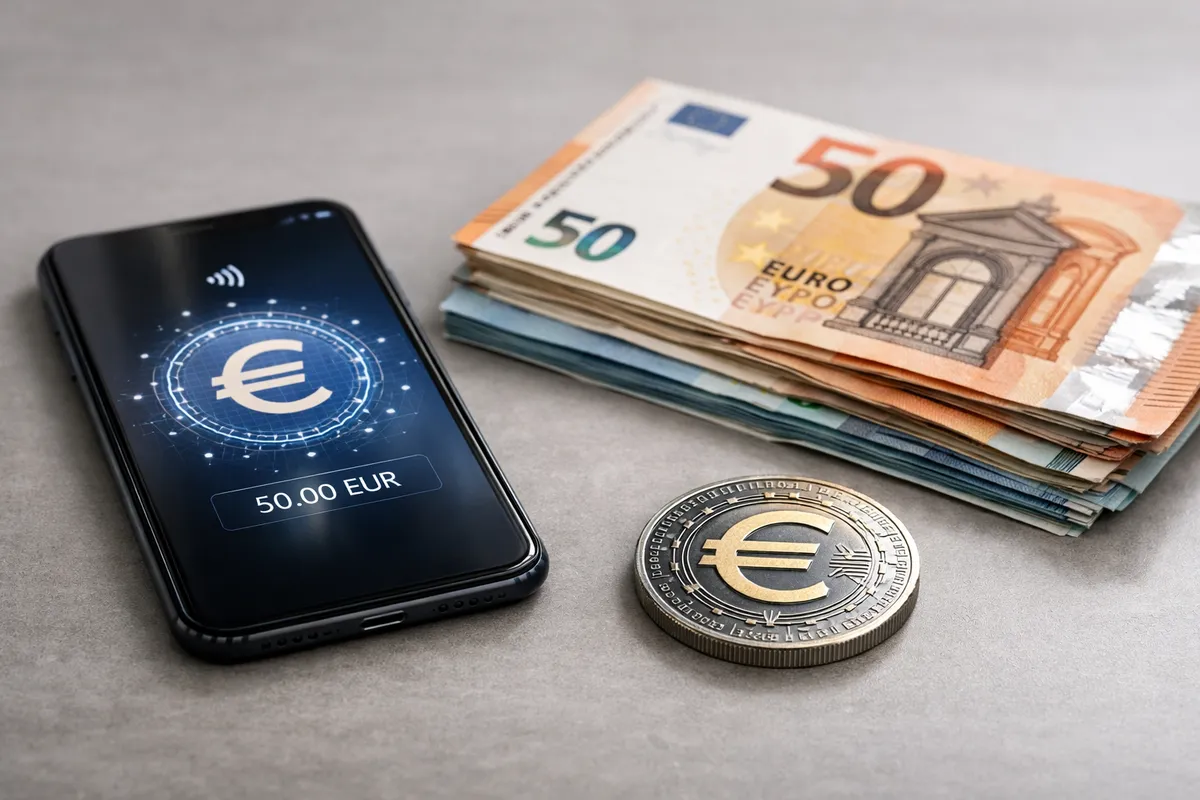
The digital euro is not a geopolitical weapon or a reaction to recent global tensions, but a necessary update to ensure that public money remains usable in a digital economy, according to Piero Cipollone, a member of the European Central Bank Executive Board. Speaking in an interview with El País, Cipollone said the ECB is responding to structural changes in how Europeans pay, not to specific political events.
The ECB, he argued, is mandated to provide a reliable means of payment and to ensure the smooth functioning of the payments system. That obligation now raises uncomfortable questions. Europe’s retail payments landscape is highly fragmented, digital payments often rely on non-European providers, and cash no longer covers everyday needs in an economy increasingly shaped by online commerce.
“At the retail level, we offer cash,” Cipollone said, “but it doesn’t fully cover people’s needs, because it can’t be used to pay digitally.” E-commerce now accounts for more than a third of day-to-day transactions by value, a gap that physical banknotes cannot fill.
Adapting central bank money to new payment habits
Cipollone stressed that the logic behind the digital euro is not new, but that the urgency has increased. Ten years ago, cash still dominated everyday payments and covered most use cases. Technological change has since altered payment behaviour across Europe.
He pointed to the rapid decline in the role of central bank money in retail transactions. In 2024, cash accounted for just 24 percent of day-to-day transactions in value terms, down from 40 percent in 2019. As a result, the ECB is being forced to adapt how it fulfils its role in providing public money for everyday use.
“All we are doing is adapting – rethinking how we give people the means to pay in this new environment,” Cipollone said.
While he acknowledged that geopolitical tensions and the “weaponisation” of economic tools increase risks, he framed this as a reinforcing factor rather than the core motivation. These risks, he said, strengthen the case for a European payment system built on European technology and infrastructure, fully under European control.
“That is what we are doing with the digital euro,” Cipollone said. Citizens would remain free to choose whether and how to use it alongside private payment solutions, but it is the ECB’s responsibility to ensure that Europeans are not exposed to excessive dependencies.
“In short, the digital euro is about safeguarding money as a public good,” he said, adding: “It is public money in digital form.”
A single public standard for Europe
Cipollone also addressed calls in the European Parliament to wait for the private sector to develop a pan-European payment solution instead. The ECB, he noted, has encouraged such efforts for years and welcomes initiatives to integrate existing systems. But fragmentation remains a core weakness.
The digital euro would be legal tender, meaning any merchant that accepts digital payments would have to accept it. More importantly, it would establish a single, open public standard accepted across Europe. Today, merchants must sign up to multiple proprietary standards set by banks and fintech providers, reinforcing fragmentation. A digital euro standard, Cipollone argued, could instead serve as a common foundation that the private sector can also build on.
He was dismissive of suggestions that the digital euro should exist only in offline form. One of the ECB’s objectives is to provide a viable European payment option for e-commerce, something an offline-only solution cannot deliver.
Beyond payments, the interview briefly touched on monetary policy and uncertainty. Cipollone stressed that the ECB remains focused on euro area conditions, with growth resilient and inflation close to target, though rising uncertainty could weigh on investment if it persists.
For the digital euro debate, however, his message was clear. The project is less about reacting to crises and more about ensuring that, as payments go digital, Europeans do not lose access to central bank money in their everyday economic lives.
Related: ECB Digital Euro User Research Highlights Offline Payments, Lower Fees and Trust as Adoption Drivers