
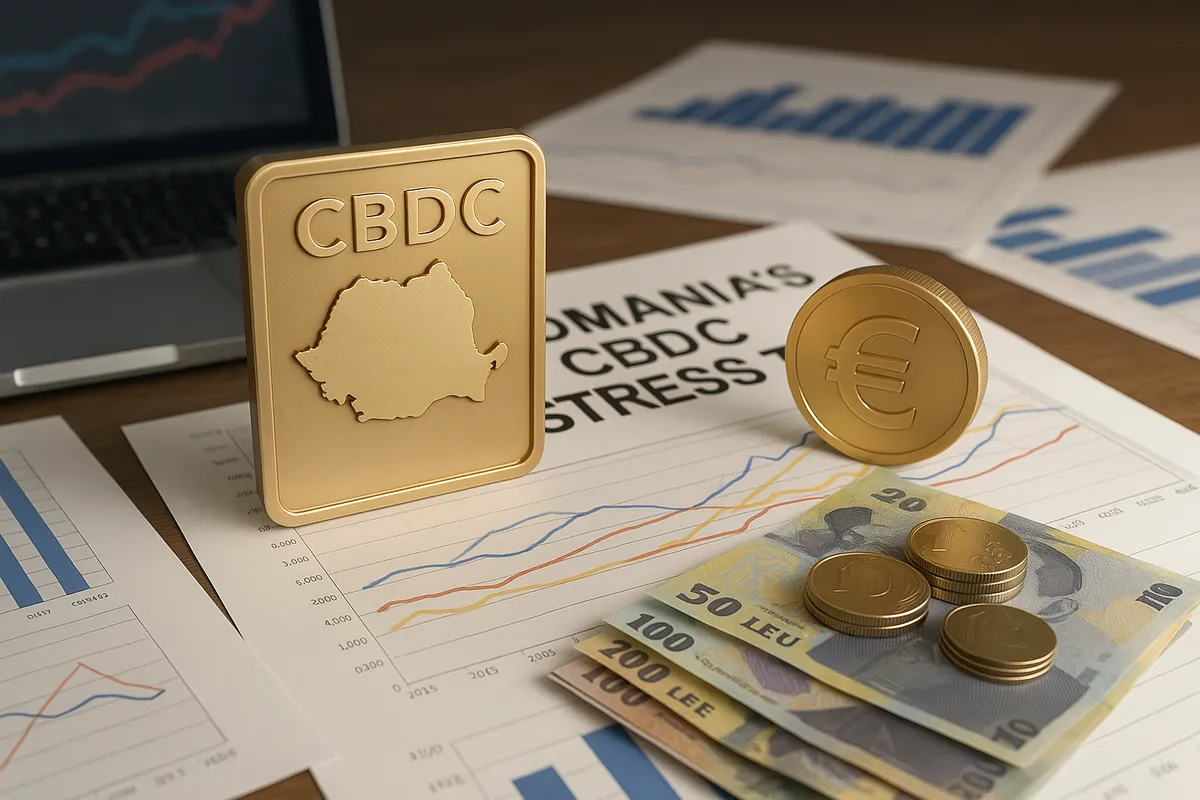
A new working paper from the National Bank of Romania (NBR) argues that a retail central bank digital currency (CBDC) can be introduced in a dual-currency economy without endangering financial stability, provided holding limits remain moderate and the instrument is designed as a payment tool rather than a high-yield savings product. Authored by Catalin Dumitrescu, “CBDC Stress Test in a Dual-Currency Setting” examines how a Digital RON and a potential Digital Euro might interact with Romania’s banking system and savings habits.
Unlike many CBDC studies that rely on intention surveys, the paper builds a synthetic population and models behaviour using machine learning and econometrics. Adoption probabilities are estimated with XGBoost and logistic regression based on digital readiness, trust in institutions and observed saving patterns, rather than answers to hypothetical questionnaires.
The results point to moderate uptake at launch. In a scenario where Digital RON and Digital Euro co-circulate, initial holdings are estimated at around EUR 1 billion, with adoption strongly driven by digital literacy and confidence in the central bank. A one-point rise in a normalised “digital trust” score increases the odds of adoption by roughly 12 percent.
7,500 RON: A Stability “Sweet Spot” for CBDC Caps
The core of the study is a system-wide stress test that maps CBDC-induced deposit outflows into bank funding pressures, portfolio adjustments and credit contraction. With a combined individual holding limit of 7,500 RON (about EUR 1,500) across Digital RON and Digital Euro wallets, more than 60 percent of banks could absorb withdrawals by drawing on cash and reserves and selling less than a quarter of their securities portfolios.
At a higher cap of 15,000 RON, the picture changes. Around 40 percent of banks would face deposit outflows above 10 percent of total liabilities, forcing sizeable asset sales and a sharp increase in wholesale funding. In this adverse setting, cumulative liquidity coverage costs for the system are estimated at about 1.96 billion RON over 10–12 years – significant but still manageable relative to the size and profitability of the sector.
The paper also quantifies how liquidity shocks propagate into lending. Regression-based elasticities suggest that for every RON 1 billion of deposits moving into CBDC, credit portfolios shrink by around 0.7–1.1 percent. In a moderate stress scenario, this translates into a temporary slowdown of aggregate credit growth of roughly 2.5–3.2 percent over the following two quarters.
Dual-Currency Design: Guard Rails Against Euroisation
Romania’s status as a “dual-currency savings economy” pushes the analysis beyond a single-currency CBDC. Dumitrescu proposes differentiated holding limits for domestic and foreign digital currencies: around 4,000 RON for a Digital RON-only scenario, EUR 500–800 for Digital Euro balances in Romania, and a higher combined cap of 7,500 RON when both are available.
The rationale is to avoid concentrated outflows from RON deposits and to limit further euroisation, while still allowing households to use both currencies for everyday digital payments. A higher aggregate cap across two wallets is justified by diversification: pressure is spread over RON and EUR rather than focused on a single segment of the banking system.
Lessons for the Digital Euro Debate
Beyond Romania, the study’s message is that CBDC risk is a policy choice, not an inevitability. A capped, non-remunerated CBDC treated as a means of payment, backed by central bank liquidity facilities and careful monitoring of wholesale funding spreads, can be compatible with bank-based credit intermediation.
Importantly, Dumitrescu argues that relatively low short-term adoption should not be seen as a reason to abandon CBDC plans. Even limited early use can help preserve monetary sovereignty vis-à-vis private stablecoins and a future Digital Euro ecosystem, while giving authorities a strategic option that can be scaled up if conditions change. The recommended path is a “conditional activation strategy” with pilots, thresholds and the ability to “start low and go slow” on limits.
For the ECB and non-euro EU central banks, the Romanian framework offers a replicable toolkit: link behavioural adoption modelling to bank-level stress tests and macro-financial transmission, then calibrate digital euro and domestic CBDC limits accordingly. It suggests that the real risk is not digital public money itself, but launching it without the kind of quantitative guard rails this study sets out.